Free to Start — No Credits, No Catch
The Free AI Video Clipper That's Actually Free
I tested every "free" AI video clipper I could find. Opus Clip, Klap, Descript, Vidyo — all of them. Most aren't really free. Here's the honest breakdown, and why we ended up building one that is.
Download Free on Mac
Free to Start with unlimited clipping. No credit card. No account required.
I Tested Every "Free" AI Video Clipper. Most Are Lying.
Let me save you the two weeks I spent on this. When you search "free AI video clipper," you get a wall of tools that claim to be free. I signed up for all of them. I uploaded the same 90-minute podcast episode to each one. And I discovered something frustrating: almost none of them are actually free in any meaningful way.
"Free" in this industry almost always means one of three things: free trial (use it for 7 days, then pay), free with limits (60 minutes per month, then pay), or free with watermarks so large your audience thinks you're promoting their brand, not yours.
I'm not saying these are bad tools. Some of them are excellent. But calling them "free" is misleading when a podcaster processing two episodes a week will hit the limit before the month is half over.
This page is the honest guide I wish existed when I started looking. I'll break down what you actually get for free at each tool, the real math on what it costs over a year, and why we ended up building Reelify AI to be genuinely free to start with unlimited processing.
What "Free" Actually Means at Each AI Video Clipper
Here's what I found after signing up and testing each tool's free plan with real content:
Opus Clip
Opus Clip gives you 60 minutes of video processing per month on their free tier. Sounds reasonable until you realize that's one short podcast episode. If you're a creator doing weekly uploads, you'll burn through that in the first week. Every export gets a prominent watermark. Once you hit the cap, you're looking at $19/month for 200 minutes — which still isn't enough for most serious creators. And you have to upload your entire video file to their cloud servers, which takes 15-30 minutes for 4K footage.
If you're looking specifically for a free, unlimited alternative to Opus Clip, see the Opus Clip free alternative unlimited page for a pricing-focused breakdown and local workflow details.
Klap
Klap's free tier works similarly — limited minutes, watermarked output, reduced resolution. The processing is cloud-based, so you're uploading gigabytes of footage to their servers and waiting. Their paid plans start around $24/month. The clip quality is decent, but the free tier is really a demo, not a usable tool.
Descript
Descript is more of a full editing suite than a pure clipper. Their free plan gives you 1 hour of transcription. It's a great product for text-based editing, but for turning long videos into short clips specifically, it's not specialized for that. Plans start at $24/month, and the AI clipping features are limited even on paid tiers.
Vidyo.ai
Vidyo offers limited free processing with their branding on exports. It's cloud-based, so same upload-and-wait workflow. Paid plans are $30+/month. The AI detection is okay but misses nuance — it tends to grab any moment with raised voices rather than genuine viral hooks.
Reelify AI
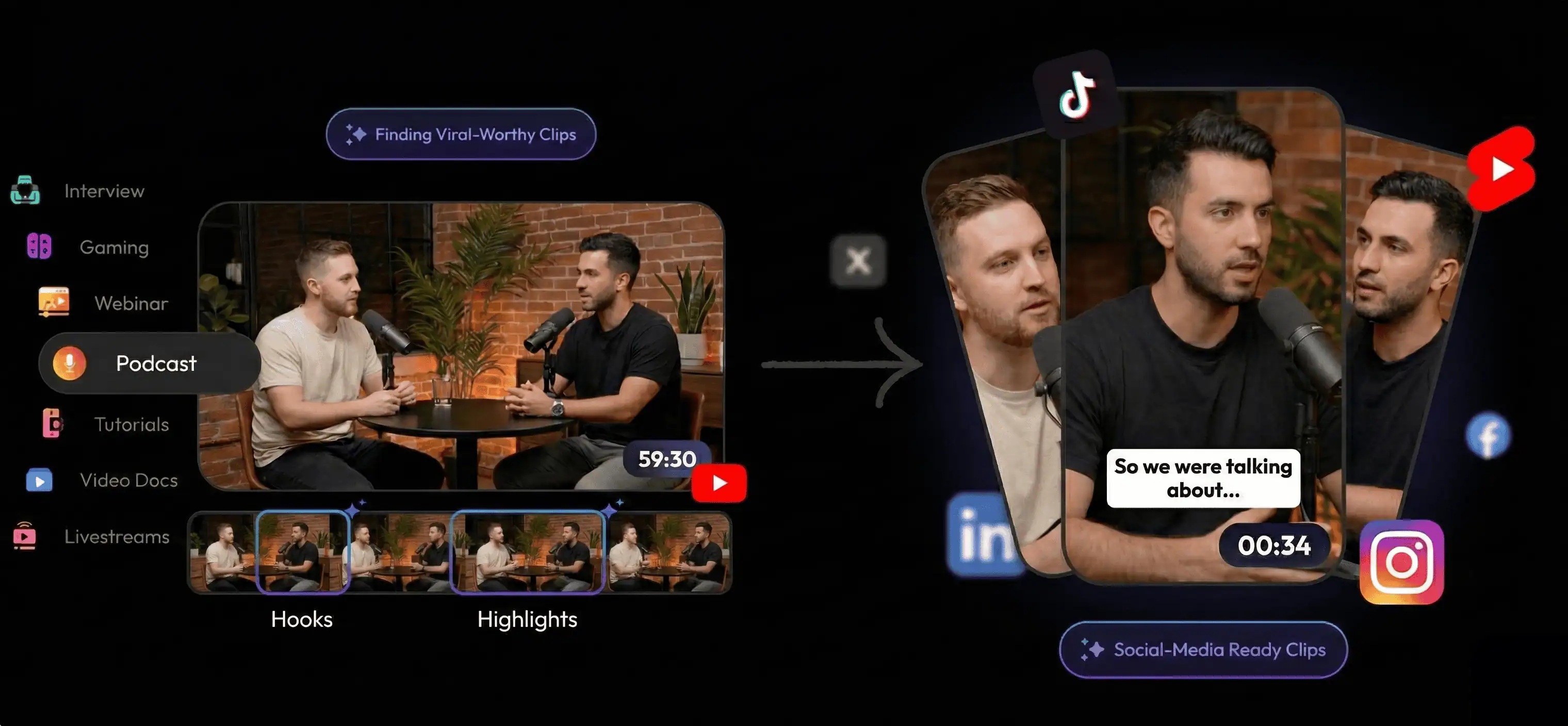
This is what we built — and yes, I'm biased, but I'll be transparent about what you get and what you don't. Reelify AI's Free to start plan gives you unlimited video processing on Mac. No minute caps. No monthly reset. Only minimal branding on export. The AI finds viral moments, generates clips, adds auto-captions, and batch exports — all for $0. It processes everything locally on your Mac, so there's no upload wait either.
The fundamental difference: Every other "free" AI clipper limits what you can process because their cloud servers cost money every time you use the tool. Reelify AI processes locally on your Mac, which costs us nothing — so we can give you unlimited processing for free.
The Real Math: What "Free" AI Clippers Cost Over a Year
Most creators don't do this calculation. They see "free" on the landing page, sign up, hit the limit, and start paying without thinking about the annual cost. Here's what happens if you're processing roughly 10 hours of source video per month — which is pretty normal for a weekly podcaster or a creator repurposing YouTube videos:
| Tool | Monthly Cost | Annual Cost | What You Get |
|---|---|---|---|
| Opus Clip | $29/mo | $348/year | 600 min/mo, cloud processing |
| Klap | $24/mo | $288/year | Limited minutes, cloud processing |
| Descript | $24/mo | $288/year | 10 hrs transcription, editing suite |
| Vidyo.ai | $30/mo | $360/year | 300 min/mo, cloud processing |
| Reelify AI (Free) | $0 | $0/year | Unlimited, local processing |
| Reelify AI (Lifetime) | $59 once | $59 total | Unlimited + advanced AI features |
Even if you buy the Reelify lifetime license, it pays for itself in about 2 months compared to any cloud-based competitor. Over 3 years, you'd save $800-1,000. But the free tier alone handles 80% of what most creators need — I use it for most of my own work.
How Can Reelify AI Stay Free to Start? (The Honest Answer)
When someone tells you something is free, your first instinct should be to ask: "What's the catch?" So let me be direct about how this works.
Most AI video clippers run on cloud servers. Every time you upload a video, they spin up a GPU instance, process your footage, store the results, and serve them back to you. That GPU time, bandwidth, and storage costs real money — typically $0.50-2.00 per hour of video processed. They pass that cost to you through subscriptions and credit systems.
Reelify processes everything on your Mac. The AI models run directly on your Apple Silicon chip — the same Neural Engine that powers Face ID and Siri. When you drop a video into Reelify, it's analyzed, clipped, captioned, and exported entirely on your hardware. Nothing gets uploaded. We don't run servers for video processing, so there's no per-user cost to pass on.
That's the honest answer. Our costs are fixed (development, updates, support) regardless of how many videos you process. So unlimited free usage is a real, sustainable business model — not a charity or a bait-and-switch.
The paid tiers exist for creators who want the Viral Context AI, which is a deeper AI model that does use cloud processing to understand semantic meaning — things like humor, controversy, emotional resonance. The free tier's Pattern AI detects moments based on audio energy, speech patterns, and visual changes. The paid tier understands what's being said and why it might go viral. Both are genuinely useful, but one costs us money to run, so that's what the paid plans fund.
What You Actually Get for $0
I want to be specific, because "unlimited free" sounds like marketing fluff. Here's exactly what the free tier includes:
- Unlimited video imports — any length, any resolution, no file size cap. I've dropped in 4-hour streams without issues.
- AI moment detection (Pattern AI) — finds hooks, emotional peaks, quotable moments, and high-energy sections automatically.
- Auto-captioning — generates word-level captions from your audio. Accurate enough that I rarely need to edit them.
- Timeline editing — fine-tune start/end points of every clip before exporting.
- 9:16 vertical export — ready for TikTok, Instagram Reels, YouTube Shorts.
- Batch export — export 10-20 clips at once. I export a week's worth of content in one batch.
- Minimal branding — your clips look like yours, not ours. While free exports include a small subtle watermark, it is nothing like the giant logos on cloud tools.
- Active Speaker detection — for multi-person podcasts, it keeps the active speaker framed correctly.
What the Paid Plans Add
Credit where it's due — the paid features exist for a reason and I use them myself:
- Viral Context AI ($59 lifetime or $15/month) — instead of just detecting energy patterns, this AI watches your video and understands context. It knows the difference between someone raising their voice in excitement vs. anger. It identifies controversial takes, unexpected revelations, and genuine laugh-out-loud moments. The difference in clip quality is noticeable if you're optimizing for virality.
- Advanced caption styling — more font options, animation styles, brand colors.
- Priority updates — early access to new features.
For someone just getting started, the free tier is more than enough. I used it exclusively for my first two months before upgrading, and my clips were already outperforming what I got from Opus Clip's $19/month plan. If you already know you prefer buy-once software over monthly tools, see the AI video clipper one-time payment page for the narrower pricing-model angle.
My Actual Daily Workflow With the Free Tier
Here's what a typical content day looks like for me. This is real — not a theoretical "imagine if" scenario:
Morning: I record a 75-minute podcast episode. When I'm done, I drop the file into Reelify. While I make coffee, it's already analyzed the whole thing — usually within a couple of minutes on my M2 MacBook Pro. I come back to 14 suggested clips.
10 minutes later: I scan through the suggestions. Most are solid — genuine hooks, emotional moments, funny exchanges. I discard 3 that are too context-dependent to work as standalone clips. I tweak the start/end points on 2 others. I batch export all 11.
2 minutes later: I have 11 vertical clips with captions, ready to post. Total time from "done recording" to "ready to schedule": about 15 minutes. No uploading. No waiting for cloud processing. No worrying about credits or limits.
Compare that to my old Opus Clip workflow: upload (20 minutes), wait for processing (10 minutes), review in browser (sluggish for 4K), download clips (5 minutes), re-add captions that didn't render right (10 minutes). That's close to an hour — and I was paying $19/month for the privilege.
Who Should Use a Free AI Video Clipper?
If you're just starting out as a creator, a free clipper should be your first choice. Don't spend money on tools until you know what your workflow looks like. Download Reelify, process a few videos, see if AI clipping fits how you create content. If it does, you've saved yourself hundreds of dollars over whatever paid tool you would have chosen.
If you're a podcaster, this is a no-brainer. Podcasts generate the most clips per video because there's constant dialogue. A single episode gives me 10-15 usable clips. At the volume most podcasters produce, cloud-based clippers get expensive fast. Free and unlimited is the only pricing that makes sense.
If you handle client content, local processing matters more than price. You can't upload NDA-protected footage to a cloud server. The fact that Reelify is also free is a bonus — the real selling point for agency work is that nothing leaves your computer.
If you're a streamer, you're sitting on hours of content every week. A 6-hour Twitch VOD processed through a cloud clipper costs $3-6 in credits per stream. Times 5 streams per week, times 4 weeks... it adds up to $60-120/month just in processing. Or you could use Reelify for free.
The Honest Limitations
I'm not going to pretend this is perfect for everyone. Here's where Reelify's free tier falls short:
1. Mac Only (For Now)
The local processing requires Apple Silicon — M1, M2, M3, or M4 chips. If you're on Windows, you can't use it yet. We're working on a Windows version, but local AI processing on non-Apple hardware is a harder engineering problem. If you need cross-platform right now, a cloud tool might be your only option.
2. Pattern AI vs. Viral Context AI
The free tier's Pattern AI detects moments based on audio energy, speech inflection, and visual changes. It's surprisingly accurate for finding hooks and emotional peaks. But it doesn't understand meaning — it can't tell that a quiet, deadpan joke will perform better on TikTok than someone yelling. The Viral Context AI on paid plans understands semantic content. If maximum virality is your goal and you have the budget, the $59 lifetime upgrade is worth it.
3. Processing Speed Depends on Your Mac
An M1 MacBook Air handles a 90-minute video in about 2-3 minutes. An M3 Pro does it in under 90 seconds. If you're processing 4K footage on an older Intel Mac, the experience won't be great. Apple Silicon is really the minimum requirement for a smooth workflow.
4. No Web Interface
Reelify is a native Mac app, not a website. You can't log in from a browser and process videos. For most people this is actually better (faster, works offline, more private), but if you need to collaborate with a team through a web dashboard, cloud tools have that advantage.
These are real trade-offs. But for someone who has a Mac and wants to clip videos without paying monthly, nothing else comes close.
How to Get Started
- Download Reelify AI — it takes about 30 seconds. No account creation, no email, no credit card. Get it here.
- Drop in any video — podcast, YouTube recording, stream VOD, client footage. Any length, any format.
- Review the AI's suggestions — adjust timing if you want, or trust the AI and batch export everything.
- Export and post — clips come out in 9:16 vertical format with captions, ready for TikTok, Reels, or Shorts.
The whole process takes about 10-15 minutes for a typical hour-long video. That's not a promise — that's literally what I do every day.
Frequently Asked Questions
Is Reelify AI really free?
Yes. The Free to start plan gives you unlimited video processing on Mac with no credits, no minute caps, and no monthly reset. The AI finds viral moments, generates clips, adds captions, and exports them — all for $0 to start. Paid plans ($59 lifetime or $15/month) add the advanced Viral Context AI, but core clipping is genuinely free.
What's the catch?
Reelify processes videos locally on your Mac using Apple Silicon, so there are no cloud server costs when you clip. That's why unlimited free processing is sustainable. The paid tiers fund the advanced Viral Context AI, which uses cloud processing to analyze viral potential. The core product runs entirely on your hardware.
How is this different from Opus Clip's free tier?
Opus Clip gives you 60 minutes per month with prominent watermarks. Reelify is unlimited with only minimal branding. Opus processes in the cloud (upload and wait). Reelify processes locally on your Mac (instant). A 90-minute podcast that takes Opus 25+ minutes to upload and process takes Reelify within a couple of minutes.
Does it work offline?
Yes. Everything runs on your Apple Silicon chip. You can clip videos on a plane, at a cabin with no WiFi, or anywhere else. The only feature that needs internet is the optional Viral Context AI on paid plans.
Why is it Mac-only?
Apple Silicon chips (M1-M4) have powerful Neural Engines that run AI models efficiently on-device. This is what makes free unlimited processing possible — no cloud servers needed. Windows support is in development, but Apple's hardware gives us the best local AI performance. iOS and Android apps are also available.
Are there watermarks on free exports?
Reelify AI's free tier has minimal, subtle branding — nothing like the large watermarks you see on cloud-based free exports. If you want completely clean exports with zero branding, the $59 lifetime plan removes it forever.
How can you offer unlimited clipping?
Unlike cloud-based tools that pay bill minute of video processed on their servers, Reelify AI runs mostly on your Mac using local processing. Since your own hardware does most of the processing, there's no reason to limit how many clips you create.
Try the Free AI Video Clipper That's Actually Free
No credit card. No account. No minute limit. Drop a video and get clips in 90 seconds.
Download Reelify AI Free
Free to Start with unlimited clipping on Mac. $59 Lifetime upgrade
available.