A Local AI Video Editor for Mac Workflows
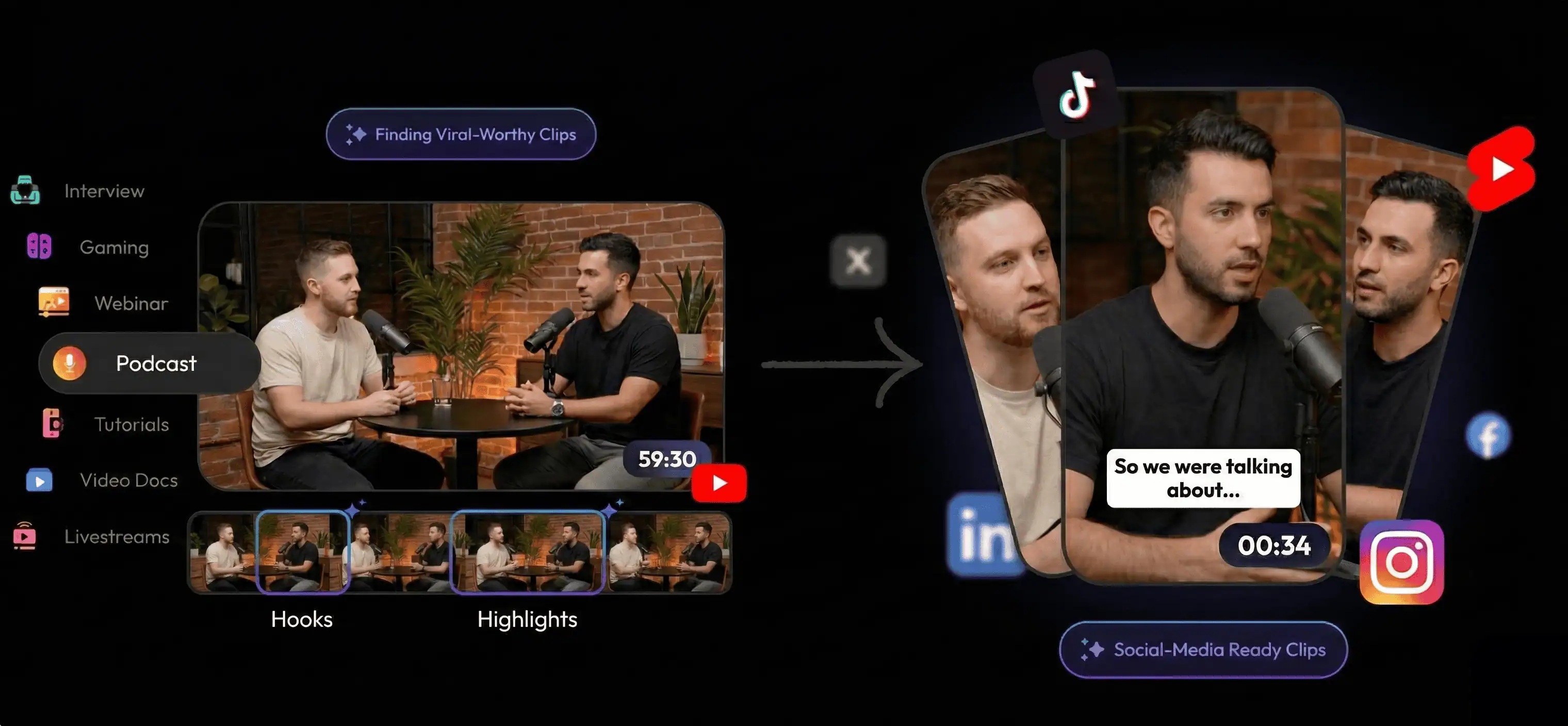
Reelify helps you turn long videos into short clips on your Mac with local AI. Review suggested moments, captions, vertical reframing, and exports in one workflow without uploading source footage to the cloud.
Reality check: local AI editing is not about replacing every editing tool. It is about handling clipping, captions, reframing, and exports on Mac without adding an upload-first cloud workflow on top of footage you already have locally.
Why Creators Choose a Local AI Editor on Mac
What changes when the editing workflow runs on your machine instead of a remote queue
Cloud-Based Editors
ReelifyAI Local Processing
Why Local AI Processing is Superior
Private Source Footage
Your videos, client content, and sensitive material stay on your Mac throughout the editing workflow. That matters for NDAs, confidential content, and unreleased material.
Lightning Speed
No upload time, no download time, no queue waiting. Drop a video and get results in 90 seconds, regardless of file size.
Captions and Vertical Reframing
Use AI to prepare clips for Shorts, Reels, and TikTok with captions and speaker-aware framing built into the Mac workflow.
Review Before Export
Suggested clips are not the end of the workflow. You can check timing, refine selections, and export from the same local editing flow.
Better Performance
Leverage your Mac's powerful hardware directly. No compression, no quality loss, no bandwidth bottlenecks.
Free to start Unlimited
No ongoing cloud costs, bandwidth fees, or storage charges. Free to start for unlimited long-form video clipping on Mac. Upgrade for pro features.
Who This Local AI Video Editor Is For
Mac workflows where local editing beats a browser-based clipper
Agency Owners: "I work with client content under strict NDAs. Uploading to cloud servers was never an option. ReelifyAI solved this completely."
Podcast Producers: "I edit unreleased interviews with high-profile guests. Local processing means zero risk of leaks or breaches."
Corporate Teams: "Our company policy prohibits uploading internal videos to third-party servers. ReelifyAI is the only solution that works."
Content Creators: "I travel constantly and often have poor internet. Being able to edit offline is a game-changer for my workflow."
Freelance Editors: "Clients love that their content never leaves my computer. It's become a major selling point for my services."
How Reelify Handles Local Editing Workflows
The technology behind clip suggestions, captions, reframing, and exports on Mac
On-Device AI
Our AI models run entirely on your Mac's hardware. No data transmission, no cloud dependencies, just pure local intelligence.
Hardware Acceleration
We leverage your Mac's GPU and Neural Engine for maximum performance. Faster processing than cloud servers, with zero latency.
Zero Data Transfer
Your videos are analyzed, processed, and exported entirely on your machine. No uploads, no downloads, no data ever leaves your control.
Why I Moved My Editing Workflow Off the Cloud
I run a small content studio. We produce podcasts for clients, record interviews with executives, and edit video for brands that take their IP seriously. For years, I used cloud-based AI clippers — Opus Clip, then Klap, then whatever was new that month. They worked fine. Until they didn't.
The moment that changed everything was a client call where the legal team asked me point-blank: "Where does our video footage go when you use this AI tool?" I couldn't give them a straight answer. The tool's privacy policy said data "may be used to improve our models." That's corporate-speak for "we might train our AI on your client's unreleased product video."
I almost lost the account. That was the day I started looking for a local AI video editor — something that would never touch the cloud. And I realized the options were basically nonexistent. So we built one.
What the Local Editing Pipeline Looks Like
Here's what happens when you drop a video into Reelify AI. I'm going to be technical because I think creators deserve to know what's actually happening with their content.
Step 1: Audio extraction and transcription. Your Mac's Neural Engine transcribes the audio to text. This happens entirely on-device using a speech recognition model that's bundled with the app. No audio leaves your computer. On an M2 chip, a 90-minute podcast transcribes in about 40 seconds.
Step 2: Moment detection. The Pattern AI analyzes the transcript alongside audio waveforms to identify potential clip-worthy moments — hooks, emotional peaks, emphatic statements, laughter, topic shifts. This runs on your GPU. It's looking for patterns that historically correlate with high engagement: sudden energy changes, quotable sentence structures, and natural start/end points.
Step 3: Visual analysis. The AI looks at visual cues — speaker changes, gestures, screen transitions, and framing. For multi-person podcasts, it identifies the active speaker so the vertical crop follows the right person.
Step 4: Clip generation. Based on all the signals above, the AI suggests 10-20 clips with start/end timestamps. You review them on the timeline, adjust anything you want, and batch export. The export uses hardware-accelerated encoding on your Mac, so even 4K exports are fast.
At no point does anything leave your computer. Not the video file. Not the audio. Not the transcript. Not the clip suggestions. The entire pipeline runs on the silicon inside your Mac.
When Local Editing Is the Safer Call
Privacy sounds like a nice-to-have until you're in one of these situations. Then it becomes the entire reason you choose a tool.
Client Content Under NDA
If you work for an agency or production house, your clients' content is legally protected. Uploading NDA-protected footage to a cloud AI tool is technically a breach — even if no one finds out. I've seen agencies lose contracts over this. With local processing, you can truthfully tell clients: "Your content never leaves my computer." That sentence has won us more business than any feature ever could.
Unreleased Content and Embargoed Material
Product launch videos, pre-release interviews, embargoed news segments — this stuff absolutely cannot end up on someone else's server before the release date. I've worked with creators who were clipping Apple event reactions, unreleased music videos, and pre-launch product demos. For them, cloud processing was never even a consideration.
Corporate and Internal Communications
Companies producing internal training videos, executive communications, or investor updates can't use cloud-based tools that might access their footage. IT departments at large companies have explicit policies against uploading internal video to third-party AI tools. Reelify being local-only is the only reason it gets approved by corporate security teams.
Working Without Internet
This one isn't about privacy, but it matters just as much for some people. I've edited clips on flights, in mountain cabins, in coffee shops with terrible WiFi. Cloud tools are useless without a stable connection. Local processing means your workflow doesn't depend on anyone else's servers being available. If that no-internet angle is the main reason you are searching, the offline video clipper for Mac page goes deeper on that workflow.
Performance: Local Mac Editing vs Cloud Workflows
People assume cloud processing must be faster because servers are powerful. In practice, that's wrong. Here's why.
With cloud tools, total processing time = upload time + queue time + server processing + download time. For a 1GB podcast file on a standard internet connection, that's 15-20 minutes just for the upload. Then you wait in a queue. Then it processes. Then you download the clips.
With local processing, total time = processing time. That's it. No upload, no queue, no download. On a modern MacBook Pro, a 90-minute podcast can be ready for review within a couple of minutes. The video is already on your hard drive, so there's zero transfer overhead.
Even if the cloud server's GPU is faster than your Mac's Neural Engine (which isn't always true for this type of workload), the time you save by eliminating uploads and downloads more than compensates. In my testing, local processing is 5-10x faster end-to-end than any cloud alternative.
Getting the Best Performance on Your Mac
A few practical tips I've learned from daily use:
- Close browser tabs during processing. Safari and Chrome can compete with Reelify for GPU resources. Closing them makes a noticeable difference on M1 MacBook Airs.
- Use SSD storage, not external drives. Reading video from a slow USB drive bottlenecks the whole pipeline. Keep your source files on internal storage for fastest results.
- Any Apple Silicon chip works. M1 is fine. M3 Pro is faster. The difference is maybe 60 seconds vs 90 seconds for a typical podcast — not enough to justify upgrading your Mac.
- 4K vs 1080p source doesn't matter much. The AI analysis runs on audio and compressed video frames, not raw pixels. A 4K source takes only slightly longer than 1080p to analyze.
If your workflow depends on local review, private source footage, faster turnaround, or simply keeping editing on your Mac, give it a try. The free tier makes it easy to test with your own footage before changing the rest of your process.
Try Local AI Video Editing on Your Mac
See how a Mac-first workflow feels when clip suggestions, captions, reframing, and exports stay local from start to finish.